

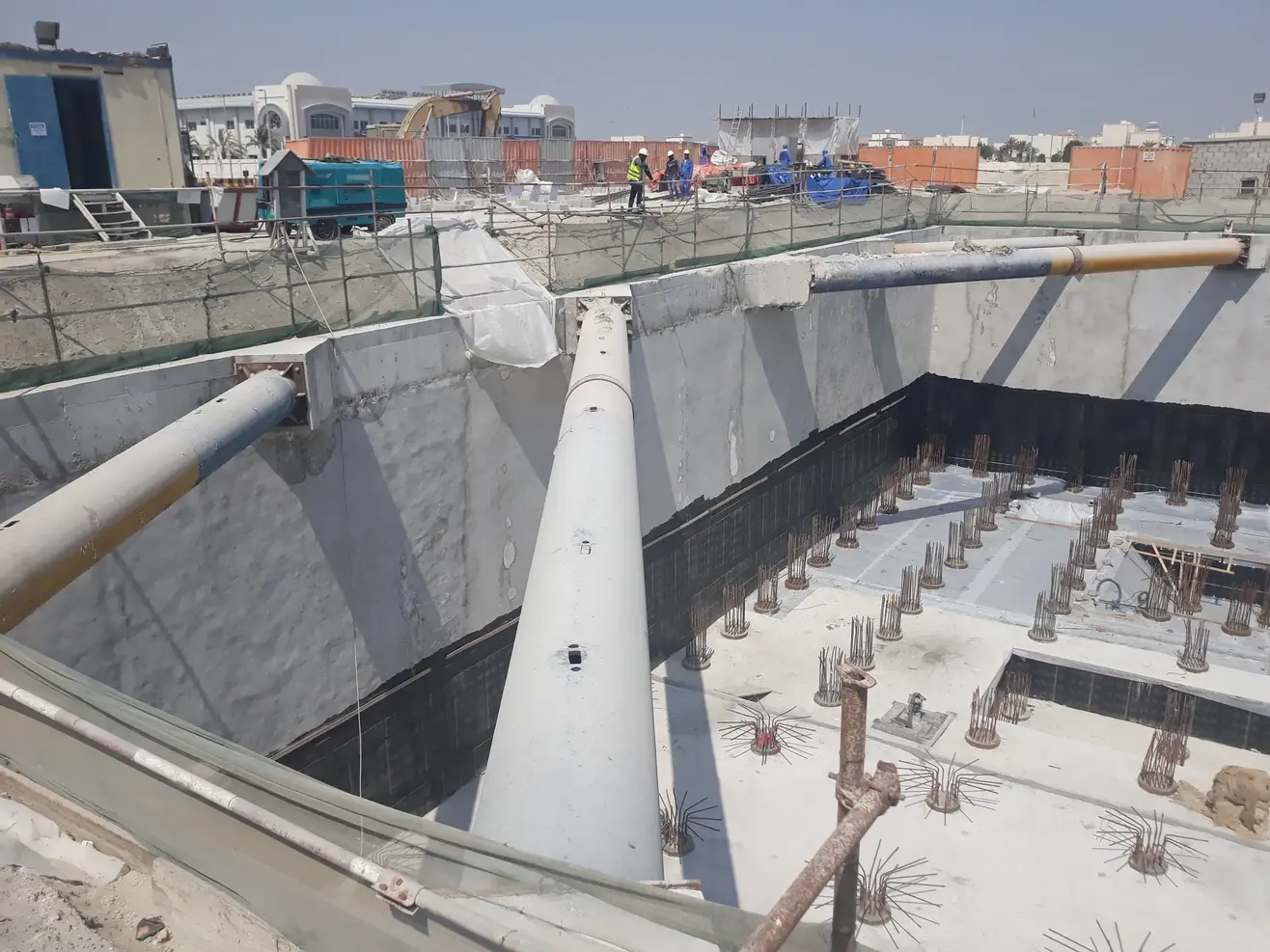
Earth retaining structures prevent landslides caused by gravity or erosion by holding back soil or rock. Earth retaining walls in deep excavations must endure high lateral earth pressures as well as hydrostatic forces induced by ground water. Many pile types and combinations are utilized to build retention systems, depending on the design requirements.
TYPES OF Shoring/wall retaining systems PROVIDED:
- Secant pile
- Contiguous pile
- Sheet pile
- H. Beam with Wood blanks OR RC blanks
- Anchoring
- Strutting and Bracing
Secant pile
Secant pile walls are used to construct in-ground retaining walls preventing water inflow in front of the wall as well as providing support for excavation works. It is made by constructing intersecting reinforced concrete piles, these piles are reinforced with steel rebar. Primary piles are constructed first with secondary piles installed in between the primary once the latter gains the required strength.
Contiguous pile
A contiguous pile wall is a row of concrete soldier piles installed so that each pile is in contact, or near contact, with piles on either side of it.
Sheet pile
Sheet piles are steel sheets with interlocking edges that are installed into the ground to provide support for excavation works. Sheet piles are mainly used for infrastructures, basements, retaining walls and others.
H. Beam with Wood blanks OR RC blanks
H. Beam are installed into the ground to provide support for excavation works. H. Beam are mainly used for infrastructures, basements, retaining walls and others.
Strutting and Bracing
During excavation, struts are employed to give such support.
The size and configuration of struts are predetermined by design engineers. When the retaining wall system has been placed underground, the earth is dug and struts are put at each required level once it has been reached.
Anchoring
A tieback is a structural member that is put in the ground to transmit applied tensile load. A tieback, which often takes the shape of a horizontal wire or rod or a helical anchor, is widely used in conjunction with other retaining methods to offer extra stability to cantilevered retaining walls.